


You sprayed it twenty minutes ago and now there is nothing. Meanwhile the person who hugged you at the door has just told you that you smell wonderful. If you have found yourself asking why can't I smell my own perfume? the answer is almost never that the fragrance has gone. It is that your nose has stopped reporting it, which is a different thing entirely, and one of the most misunderstood facts in wearing scent.
What is actually happening
The effect has a proper name: olfactory adaptation, known more casually as nose blindness. It is the temporary, involuntary suppression of your ability to detect a particular smell after continuous exposure to it. Nothing has been damaged and nothing has been lost. The signal is being switched down, in two places at once.
The first is at the receptors themselves. Odour molecules bind to receptors in the lining of the nose, which triggers a chemical cascade that makes the nerve fire. That same cascade also sets in motion the mechanism that quiets it, so the very act of smelling something begins the process of ceasing to smell it. The second is higher up, in the brain, which learns within minutes that a constant signal carries no new information and quietly stops passing it on to conscious attention. Most of the drop happens in the first few minutes; by fifteen or twenty, the fragrance has usually fallen below the threshold at which you notice it at all.
At a glance
- The first few minutes: receptors begin damping their own response to the molecules they have just detected
- Fifteen to twenty minutes: the scent typically drops below conscious perception for the wearer
- Two to five minutes of fresh air: most of that sensitivity returns
None of this affects what anyone else perceives. Their receptors are not adapted to your fragrance, so they are still receiving it at full strength.
The system is working exactly as designed
It helps to understand that this is a feature, not a failing. The nose evolved as an early warning system, and what matters to an early warning system is change. A smell that has been present and unthreatening for twenty minutes is, by definition, not news. Suppressing it frees the sense to register the next thing: smoke, spoiled food, someone approaching.
The same mechanism is why you cannot smell your own home, though visitors can describe it in detail, and why a perfumer working through a morning of materials must be careful about how long they spend with any one of them. Human olfaction is built around contrast. Remove the contrast and you remove the perception. A constant signal, held long enough, becomes no signal at all.

Why your favourite scent disappears fastest
There is a particular unfairness worth knowing about. Adaptation is not uniform across every smell. Research into habituation has found that pleasant, moderate, familiar odours are suppressed more readily than sharp or unpleasant ones, which makes sense if the system's priority is threat detection: a scent the brain has classified as safe requires no further attention.
The consequence is that the fragrance you love most and wear most often is, neurologically speaking, the one you will lose soonest. The perfume you find slightly odd on first wearing may stay perceptible to you for longer than the one you adore. That is not a comment on quality. It is a comment on how quickly your brain decided it had nothing to worry about.
Material weight plays a part too. Lighter, more volatile molecules clear from the receptor area quickly, giving those receptors a chance to recover; the heavier materials that make up a base, the woods, resins, ambers and musks explored in Naturals, Isolates, and Modern Molecules, linger and hold the adaptation in place. This is one reason the drydown, the part of a fragrance designed to last longest, is so often the part the wearer is least able to perceive.
The respray trap
Here is where the misunderstanding becomes a practical problem. You cannot smell your perfume, so you reasonably conclude there is not enough of it. You add more. Your receptors adapt to the higher concentration and fall silent again. You add more still. By the afternoon you are wearing several times what you started with, perceiving exactly the same silence you perceived at the beginning, while everyone else in the room is perceiving something considerably louder than you intend.
The trap is that the absence of a signal feels identical whether the cause is adaptation or evaporation. Your conscious mind cannot tell the two apart, so respraying always feels like the sensible response. It is worth deciding in advance that it is not, and that once a fragrance has been on your skin for twenty minutes your own nose has been quietly retired as a measuring instrument for that day.
The bowl of coffee beans does not work
Walk up to almost any fragrance counter and you will find a dish of coffee beans, offered with the instruction to sniff between samples to clear your palate. It is one of retail's most enduring conventions, and it does not do what it claims.
When this was actually tested, participants who sniffed coffee beans between fragrances identified a new scent no more accurately than participants who simply sniffed ordinary air. There is no mechanism by which it could work. Coffee aroma is not neutral; it is one of the most complex smells there is, engaging a great many receptor types at once. What it provides is a strong, distracting, pleasant interruption, which feels like a reset without being one. Your receptors for the materials you were just testing remain in precisely the state you left them.
This is worth knowing not to be contrarian but because believing in a palate cleanser that does not cleanse leads people to trust comparisons that were never valid. If you have ever tried six fragrances in a shop with coffee beans in between and come home unsure why none of them smelled like themselves afterwards, this is why.

What actually resets a nose
Recovery begins the moment the molecules stop arriving, and it is quicker than most people expect. Stepping outside into fresh, moving air for two or three minutes returns the greater part of your sensitivity; five minutes returns close to all of it. No equipment, no props, nothing to buy.
The method perfumers themselves tend to use is even simpler. They smell the crook of their own elbow, or an unscented patch of their own skin. You are already fully adapted to your own natural skin scent, which means it registers as nothing, and a few breaths of nothing is exactly what an overloaded receptor population needs. It looks eccentric in a shop and it works better than the coffee.
For the longer term, rotation. Wearing the same fragrance every day without a break lowers your baseline sensitivity not only to that scent but to structurally similar materials, so a new fragrance sharing that family will seem weaker to you than it genuinely is. Alternating between two or three compositions across a week keeps each of them more vivid, and has the side effect of making an old favourite feel new again after a fortnight away from it.
You are the wrong person to ask
All of this leads somewhere slightly humbling. On any given day, the least reliable judge of how your perfume is performing is you. Everyone else has an unadapted nose. Their perception of your fragrance is simply more accurate than yours, and it stays more accurate for as long as you are wearing it.
This applies to more than dosage. When people say a fragrance does not last on them, it is often true that it lasted perfectly well and they stopped perceiving it hours before it left, a confusion worth separating from the genuine factors that shape wear, which How Concentration Shapes Longevity covers properly. It also applies to the trail a fragrance leaves behind you, which you will essentially never experience and which is described in The Art of Sillage. Skin makes its own contribution to all of this, as Skin Chemistry and Scent sets out.
The reframe worth holding onto is this: a perfume was never really for the wearer's own nose. It is for the room, for the person standing close, for the coat collar in three weeks' time. That you cannot smell it is not the fragrance failing to reach you. It is the fragrance having already gone where it was always going.
Why any of this matters
There is a particular kind of anxiety that comes with not being able to smell yourself, and it pushes people toward wearing more than they mean to, or toward abandoning a fragrance that was doing exactly what it should. Understanding adaptation dissolves most of that. It lets a scent be worn lightly and trusted, which is how it was designed to be worn. And there is something quietly appropriate in a sense that gives its best work away: the perfume you cannot perceive is the one other people are carrying home, attached to an ordinary afternoon that they will remember for reasons neither of you chose.
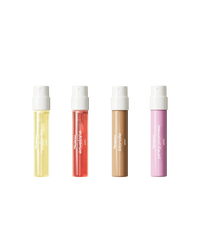
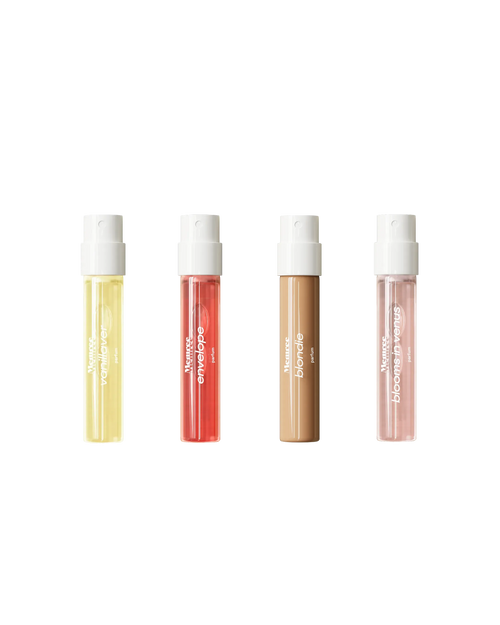
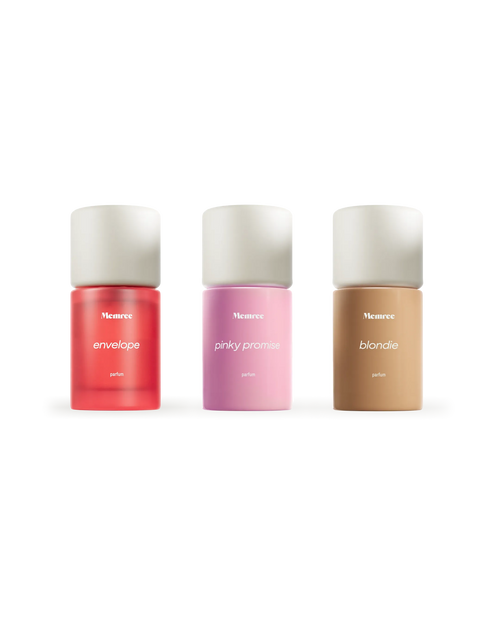
A note from Memree: we compose our parfums at extrait strength, 28 to 33 per cent perfume oil, a concentration we set individually for each scent, where it holds its depth and carries through the day. The honest way to know a fragrance is a day on your own skin. It's why every Memree journey starts with a discovery set: four scents, worn properly, before you commit to a bottle.
A few common questions
Why can't I smell my own perfume after twenty minutes?
Because of olfactory adaptation. Your receptors damp their own response to a constant smell, and your brain stops passing the signal to conscious attention. Most of the drop happens within the first few minutes, and by fifteen to twenty the fragrance usually sits below your own threshold while remaining fully perceptible to everyone else.
Does nose blindness mean my perfume has worn off?
Almost never. Adaptation and evaporation produce the identical experience of silence, which is why they are so easily confused. The reliable test is someone else's nose, or a few minutes of fresh air before you judge.
Do coffee beans reset your sense of smell?
No. When tested directly, sniffing coffee beans between fragrances produced no better identification than sniffing plain air. Coffee is an intensely complex smell rather than a neutral one, so it distracts rather than resets. Fresh air, or your own unscented skin, works better.
How do I smell my own perfume again?
Step outside into moving air for two or three minutes, or smell the crook of your elbow where no fragrance has been applied. Both allow the adapted receptors to recover. Respraying is the one thing that will not help, since it deepens the adaptation it is meant to solve.
Does wearing the same perfume every day make it worse?
Yes. Daily wear lowers your baseline sensitivity to that fragrance and to materials structurally like it, so everything in that family starts to seem quieter than it is. Rotating between two or three scents across a week keeps each one distinct.